- Details
- Written by Gordon Prentice
Last night, in a brief deputation to Council, I asked for sight of the agreement in principle that the Town entered into with Bob Forrest on the land swap. I explained why this was important. The land swap allowed for the manipulation of the development’s Floor Space Index resulting in a much bigger building than most people ever believed possible. 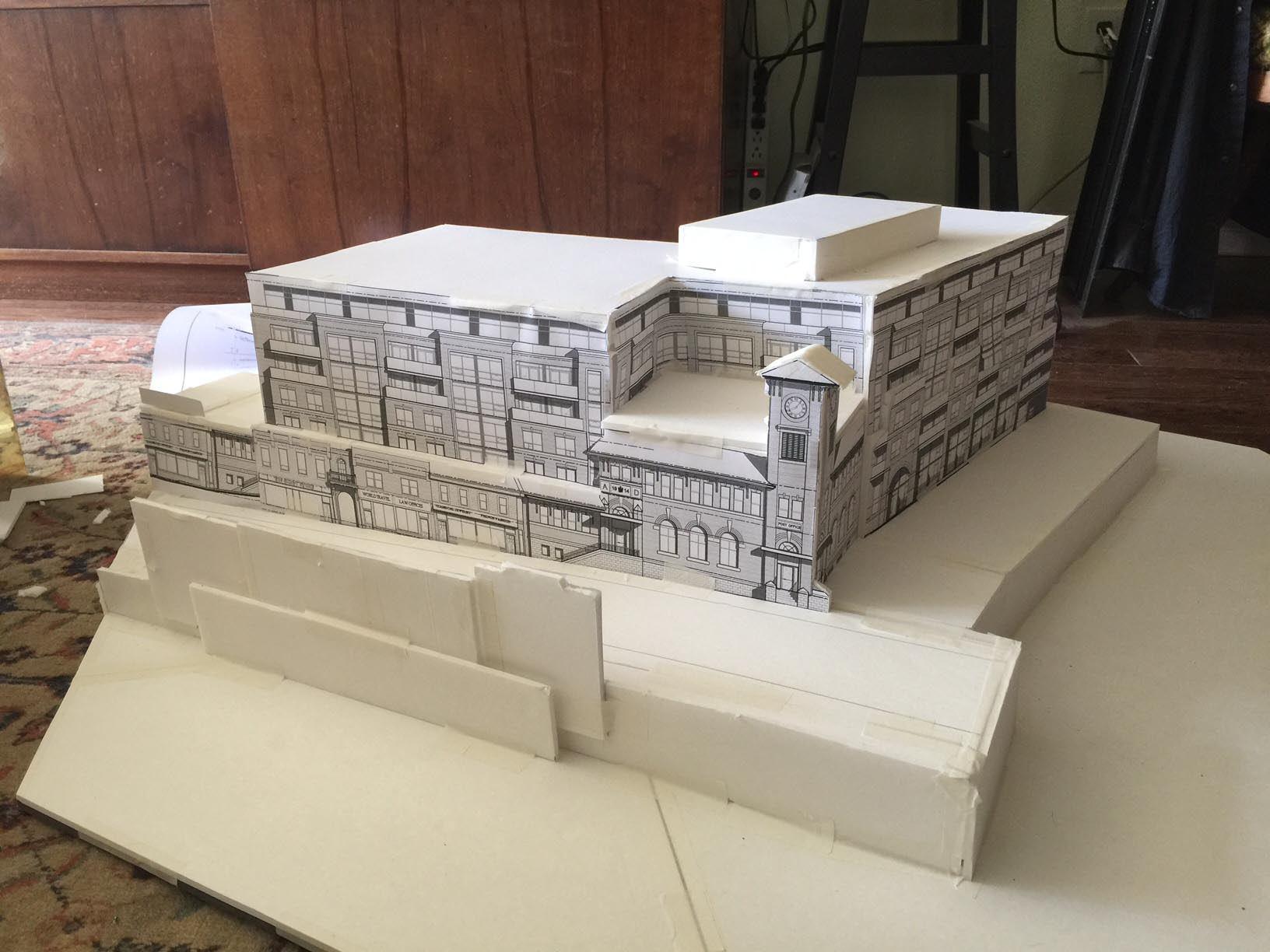
Of course this agreement was never nailed down. But the prospect of it was enough to keep Forrest hoping that something would come of his speculative gamble and that, at the end of the day, he would get his Clock Tower development and his clear profit of $10m.
In the early days, he threatened to walk out.
Way back in October 2012 when he was teeing things up, he told Newmarket's CAO, Bob Shelton:
"We are spending money to work out issues with Heritage and BIA. The cost of preparing a complete application for zoning is far too onerous for us to undertake without having (redacted). Given that we have spent over $100,000 on reports and design, in the last 30 days, if the above is not going to fly, we prefer to withdraw right now."
Dance of the Seven Veils
In a dance of the seven veils extending over many years the Town gave him enough encouragement to keep him interested. He got his "agreement in principle".
Forrest's initial planning justification report, prepared for him by MHBC, was published in August 2013. The second and final planning rationale report (also prepared by MHBC) was published on 27 January 2016.
The 2016 version contained the following sentences that were absent from the first:
"The owner has an agreement in principle with the Town that will allow for a land exchange and strata agreements that will accommodate sub-grade parking for the rear of the Proposal, while allowing the Town to own and operate the surface. The Subject Lands include certain lands the Town wishes to own and operate, and certain lands the Owner wishes to utilize for development purposes. The agreement in principle is conditional upon development approvals on the Subject Lands."
A few weeks after that report had been published, on 23 February 2016, the Town Solicitor, Esther Armchuk, told me
"Council last dealt with the matter (a land exchange request from the Clock Tower developer) in closed session on 24 June 2013."
We know from the Planning Staff report that went to the key Committee of the Whole meeting on 28 November 2016 that:
“… the zoning amendment application process allows for an applicant to apply for a rezoning of lands on behalf of the owner with the owner’s authorisation. In this instance, staff is satisfied that the Town’s authorisation to proceed with a rezoning of its lands is understood to be granted in order to implement the staff recommendations, as amended, in Closed Session Report 2013-05 which were adopted by Council on June 24, 2013…”
However, we still don’t know the full extent of what that Closed Session staff report said.
So what really happened?
Van Bynen is a friend of Forrest. They both want to see intensification of the old downtown. Van Bynen believes the jumble of old buildings on Market Square is an eyesore. He wants them gone. He tells Bob Shelton and/or Rick Nethery that he is in favour of the kind of intensification Forrest is proposing and can they find a way to make it happen. Forrest provides the solution with his cunning land swap.
I am prepared to believe most councillors were unaware of the FSI manipulation. Throughout the Clock Tower documentation there is a figure (from “experts”) stating the development had an FSI of 2.9 with no countervailing commentary from the Town’s planning staff on how it was derived and what the implications were. The absence of such a commentary was truly shocking. It was a deliberate attempt to mislead.
In a debate on Transparency and Disclosure of Information on 29 September 2014, Regional Councillor John Taylor told us:
“… in camera discussions go through a process and most of them eventually, if not all of them, eventually come out of camera. You go through a process that takes time and staff review it and they report back to us how to bring it out in its entirety or partially and at what stage.”
That is wishful thinking – especially when these reviews involve the very same staff who are designing and implementing policy in the name of elected officials.
This email address is being protected from spambots. You need JavaScript enabled to view it.
Freedom of Information Requests
A batch of FoI Requests relating to the Clock Tower has been posted on the Town’s website in the last week. You can review them here.
A Freedom of Information request (A17-17-15) which relates only to 178-180 Main Street South states that in respect of the Closed Meeting on 24 June 2013:
"no agreement exists related to the acquisition and/or disposition of land in connection with the Old Post Office redevelopment at 178-180 Main Street."
Maybe that FoI request was too narrowly drawn. Today, I have put in an FoI request requiring the Town to disclose
"any agreement or agreement in principle related to the acquisition and/or disposition of land reached by the Town in respect of the Clock Tower Subject Lands being 178-194 Main Street South."
Deputation to Council on 24 April 2017
Prentice: Thank you very much Mr Mayor. I don't think I need five minutes to say what I have to say.
The Architectural Conservancy of Ontario will formally be seeking Party status at the OMB in just over one week's time. And we will be supporting the Town's position, broadly speaking, with a few caveats, but we think the Town on 28 November and 5 December did a terrific job, collectively. So that will be our position.
But I want to be able to say to the OMB at the prehearing and thereafter that we have had sight of this famous agreement in principle - if it exists or not - and the details of the proposed land exchange.
And you may ask and people will ask why is this so important. And it is important for this reason.
The land swap allows a manipulation of the Floor Space Index which, in turn, influences the built form. So in the public meetings - and we saw Ron Eibel's model and everything - and lay people like myself said how on earth is that possible? I remember saying these very words. How on earth is it possible?
It was possible because the Floor Space Index had been manipulated by using land in the ownership of the Town under Market Square. So that is why we need the information.
Now, can I ask you a question? Is it allowed to ask a question Mr Mayor?
Mayor: But we are not going to get into a debate. You can ask the question but we will receive your deputation. 
Prentice: Am I allowed to ask a question?
Mayor: Go ahead.
Prentice: My simple question is this. Were you Mr Mayor - this is a question for all councillors but I'll direct it at you - were you aware of the potential for manipulation of the Floor Space Index before, say, the 28th of November 2016?
Mayor: I am not even aware that there was manipulation of the Floor Space Index. That needs to be resolved with staff and that's a matter that will be discussed at the OMB.
Prentice: OK
Mayor: Not here.
Prentice: And my second and final question is (this). You said on 28 November the report prepared by the staff was comprehensive. But we know it was misleading because the Planning Director has said as much. That important report that was being put forward to council for decision had an FSI of 2.9 and Mr Nethery said of course it was higher than that. He said that. There is no dispute. That is what he said. And my last question to you is this. Were you aware of that deception?
Mayor: First of all, I take exception to you using the word deception. And I also take exception for you inferring it was misleading information. And you need to be prepared to defend that. But this is not the place to discuss that. The place to discuss this is at the OMB. Let the OMB decide what is appropriate. You deputation here is to request information to be released. There is a process and a protocol for information to be released. I believe you are aware of that. It is my intention to follow that process. This municipality is governed by the Municipal Freedom of Information and Protection of Privacy Act. We will respect that because that is a Provincial Statute. It is an obligation of this municipality and I have no intentions of by-passing that.
Prentice: Fair enough. Are there any questions?
Mayor: There being none then it would be appropriate to receive this deputation. Can I have a motion please? All those in favour. Carried.
Prentice: Thank you.
- Details
- Written by Gordon Prentice
The Clock Tower cannot be built. So what is the point of Forrest appealing to the OMB?
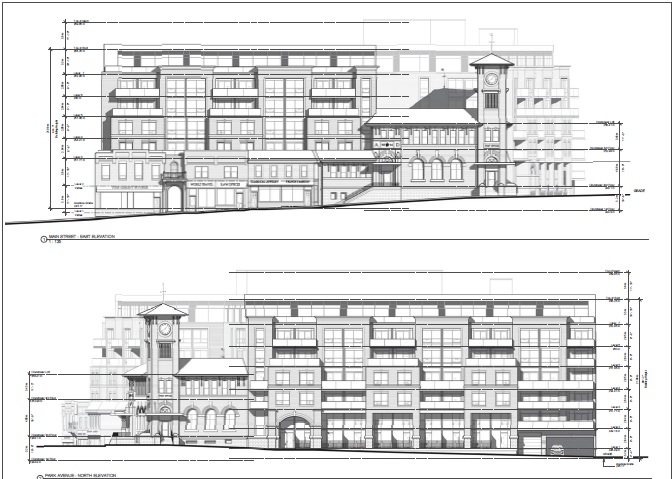
I have blogged before about the sheer craziness of having to spend public money to defend against Bob Forrest's appeal to the OMB for a building that cannot be built. The Clock Tower development needs Town owned land which is not forthcoming.
Even if it were to allow Bob Forrest's appeal, are we seriously expected to believe the OMB has powers to expropriate public land in favour of a private developer and determine the quantum of compensation that would be payable by Forrest to the municipality?
Just to pose the question illustrates its absurdity.
But, perhaps, we are not alone in this lunatic world. 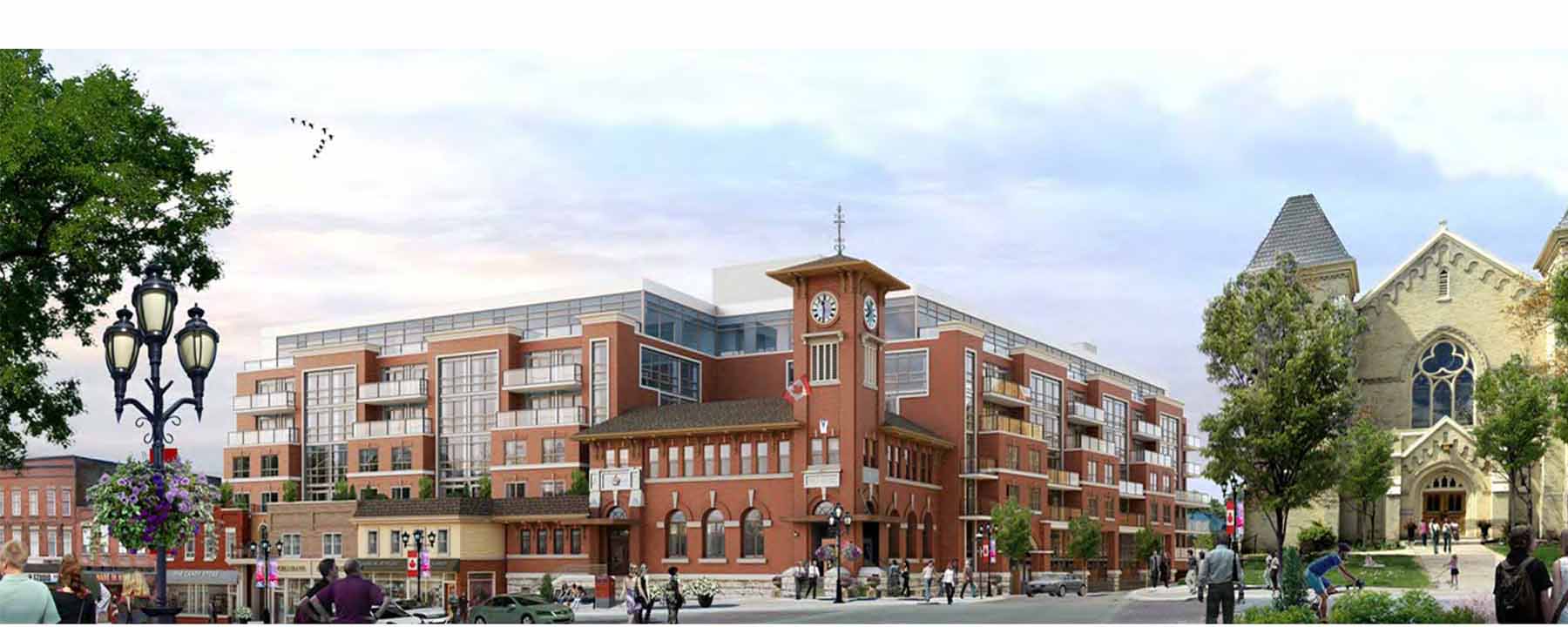
All eyes on Richmond Hill
I see another OMB Hearing is to begin on 8 May 2017 in Richmond Hill.
In it, CIM Developments Inc are appealing the failure of the Town of Richmond Hill to amend the Official Plan to change the existing designation of the land CIM wants to develop from "Neighbourhood Commercial" to "High Density Residential". The developer wants a mixed use development of 81 townhouses and two six storey residential buildings and commercial space. Apparently, CIM Developments doesn't own all the land it needs. Sound familiar?
Sam and Joanne Gideon are amongst the Parties.
One of their issues asks:
"Does the Board have jurisdiction to approve a draft plan of subdivision that shows any aspect of the appellant's proposed development (including a road allowance) on lands which are not owned by the appellant?"
and again
"Should any aspect of the appellant's proposed development, including any portion of a road allowance or future access road off Elgin Mills Road East, encroach on, or constrain the long term viability of lands municipally know as 865 Elgin Mills Road East, which lands are not owned by the appellant?"
This land is my land. This land is your land.
It is, of course, possible for a developer to submit a zoning by-law amendment covering land he or she doesn't own. But I have always assumed those affected would have the opportunity to comment and make representations. 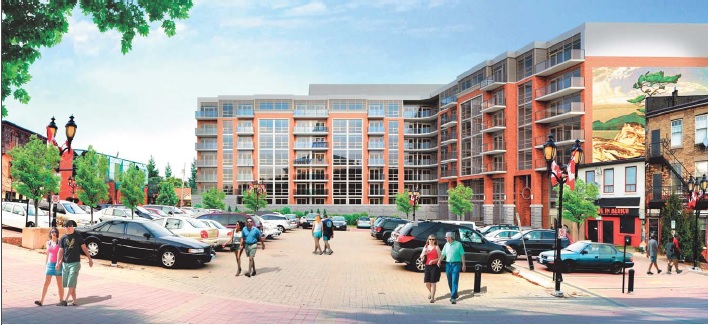
So, when Bob Forrest approached the Town with his proposed land exchange to facilitate his development at the Clock Tower, the Town, presumably, would have taken a view. It is just that we, the great unwashed, were not let in to the secret.
In a nutshell, the proposed land exchange (whether there is an agreement in principle or not) allowed for the manipulation of the Clock Tower development's Floor Space Index which directly impacted on its built form. It was a lot bigger than many people ever thought possible in the old downtown, protected as it is by the Heritage Conservation District Plan and/or Heritage Conservation District By-law. Take your pick. (The photo above shows the development as seen from the historic Old Town Hall in Market Square.)
If things go pear-shaped and Forrest loses his appeal I suppose he could exact revenge by putting in a planning application for a seven storey apartment building on the site of the municipal offices at 395 Mulock Drive.
Forrest could plausibly argue the area is ripe for intensification and his condo is just the kind of intensification Mulock Drive needs. It is close to the proposed Mulock GO Rail Station and some kind of secondary plan for the area is already being worked up. Does it really matter that Forrest doesn't own the land at 395 Mulock Drive?
I think we should be told.
This email address is being protected from spambots. You need JavaScript enabled to view it.
- Details
- Written by Gordon Prentice
Background: The Clock Tower OMB prehearing kicks off at 10am on 3 May 2017 in the Council Chamber at 395 Mulock Drive, Newmarket. It is open to the public.
Clock Tower developer Bob Forrest has hired the silver tongued planning lawyer, Ira Kagan, to represent him at  the OMB. Kagan is a skilled operator now at the top of his game. He has huge experience and a will to win. He will be formidable. He doesn't work with a broad brush. He loves detail.
Kagan represented the developer Marianneville at the OMB Glenway Hearings and wiped the floor with the Town. I observed his way of working. After quizzing a witness - and before finishing his cross examination - he would pirouette and face his team behind him. Looking at each of them in turn he would say "Have I missed anything?" I was hugely impressed. He never did miss anything.
The Town's counsel, the catatonic Mary Bull, was in a difficult position. If she had swivelled round she would have seen a row of empty chairs. The Town's planning department had, of course, boycotted the OMB Glenway Hearing.
Intensification v Heritage
We know the key issue for Kagan is "intensification v heritage". He believes the Town has focussed exclusively on heritage - and, by implication, ignored intensification. He says the Town should judge the Clock Tower application by the policy regime in place at the time it was formally submitted to the planning department and not against the Heritage Conservation District By-law that was passed a few months afterwards.
I take these points in turn.
Intensification
Van Trappist is Kagan`s ally. The Mayor's infamous unguarded remark about the Clock Tower being just the kind of intensification that Main Street needs will live on long after he has gone. In his statement to the Committee of the Whole on 28 November 2016 after losing the vote he talked about the Town's investment in the downtown business district and how
"it has long been understood that intensification was the next logical step".
Yet, despite this, late last year the Town won the Institute of Planners award for the best Main Street in Canada. 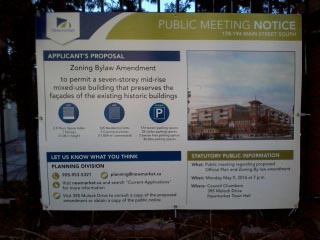
And one of the Town's senior planners, Adrian Cammaert, writing in the University of Waterloo’s PCED Journal (Papers in Canadian Economic Development) in 2016 said this:
"One of the Historic Main Street's greatest strengths is its location. As part of the GTA, Newmarket is part of and accessible to the largest concentration of people in the country... The Historic Main Street area's first impression is another advantage. This attribute can be difficult to quantify due to its subjectivity, but the area's visual attributes such as its strong 19th Century building stock, well maintained streetscape and attractive businesses result in a very positive first impression for a visitor. The 2014 approval of a Heritage Conservation District for Main Street South further verifies this impression as it relates to the physical condition and abundance of the area's historic building stock."
Cammaert concludes with this:
"Newmarket's Historic Main Street has experienced tremendous revitalisation over the past 15 years to the benefit of local residents and tourists alike."
Forrest’s dereliction
The great irony is that Forrest, in pursuit of his Clock Tower development, has contributed to an air of dereliction by evicting his business tenants and shuttering the historic commercial properties on Main Street South. They have been boarded up for years. 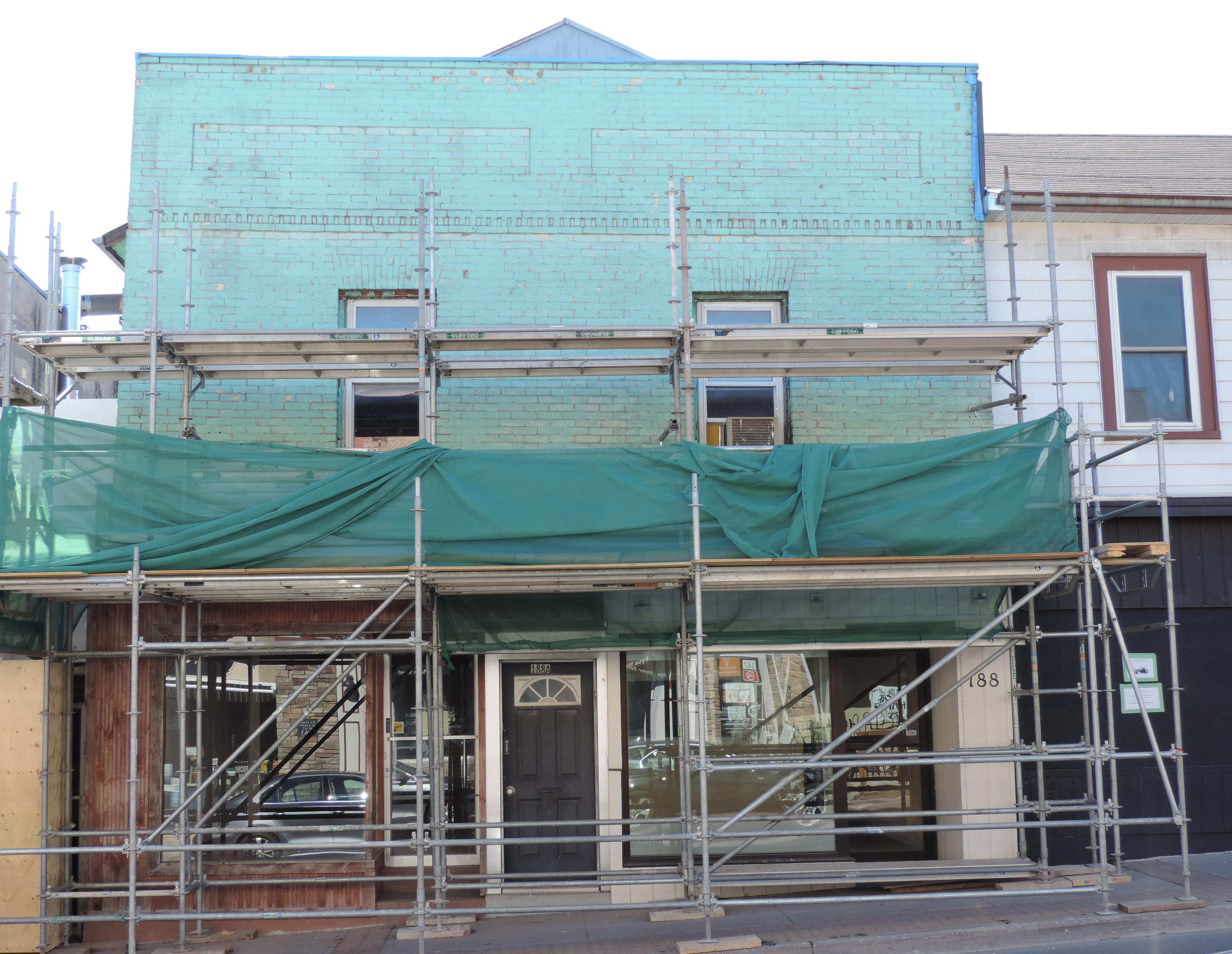
So, how will the wily and artful Ira Kagan play this?
He will say the Town has a policy for the Historic Downtown that pulls in different directions - on the one hand intensification and revitalising the old downtown and, on the other, preserving and protecting the Town's historic built heritage. Forrest's own heritage consultants, Goldsmith Borgal, recognised this alleged dichotomy and concluded that, at the end of the day, it was a matter for councillors to decide. Kagan will say the Town staff focussed on heritage and neglected the other part of the equation, "intensification".
Prepare for a deluge of Official Plans, Regional Plans, PPSs and GGHs
At the OMB Hearing, Kagan can be expected to talk at great length about the growth plan, provincial policy statements and that kind of stuff. He has a template ready that he can use.
Unfortunately, there is no transcript for the OMB Glenway Hearing but we have Kagan's written closing submission which focussed on intensification in the Newmarket context. We also have the OMB Glenway decision of 18 November 2014 which I quote at length to give context. The adjudicator and OMB Vice Chair, Susan de Avellar Schiller, said this:
“[52] The 2005 PPS (Provincial Policy Statement), the 2014 PPS and the GGH (the Provincial Growth Plan for the Greater Golden Horseshoe) all refer to intensification using similar and occasionally identical language.
[53] Intensification is encouraged generally.
[54] Policy 2.2.6(b) of the GGH is clear that municipalities are to:
...encourage intensification generally throughout the built up area...
[55] Then at Policy 2.2.6(f) municipalities are to:
...facilitate and promote intensification...
[56] Intensification is defined as:
The development of a property, site or area at a higher density than currently exists...
[57] These requirements are distinct from the GGH requirement that municipalities, at Policy 2.2.6(e):
...recognise urban growth centre, intensification corridors and major transit station areas as a key focus for development to accommodate intensification...
[58] Intensification areas include the areas listed in Policy 2.2.6(e) and also include:
... other major opportunities that may include infill, redevelopment...
[59] While intensification areas are to be identified and recognised by municipalities, the GGH does not limit intensification to intensification areas.”
and so it goes on. In paragraph 61 she sums it up this way:
“... designated growth areas or intensification areas are areas designated by the municipality. While these areas may be the focus for achieving intensification targets, they are not the only locations where intensification can occur.”
That gives Kagan all the leeway he needs to make the general case for the intensification of the old downtown. However, we already know from the Planning Staff report of 28 November 2016 that the Clock Tower development is not needed for the Town to hit its Provincial target.
But how is the intensification going to be accommodated in a Heritage Conservation District?
Answer: Remove the Clock Tower from the Heritage Conservation District.
Heritage Conservation District Plan and By-law
Kagan will make great play of the fact that Forrest's completed application was lodged 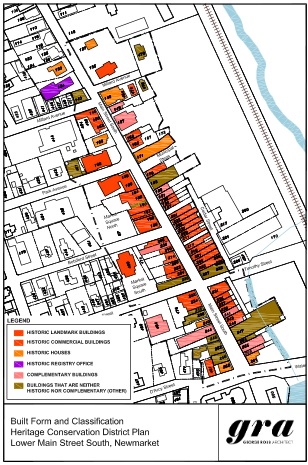 with the Town and deemed "complete" before the Town got round to enacting its HCD By-law.
In 2013, the Town's Director of Planning, Rick Nethery, was of course aware that Forrest was about to submit a heritage destroying planning application involving the demolition of historic structures. Despite this he told me the By-law would have to wait until 2014 because the cost of hiring staff to police it was not in the Budget.
There was a huge outcry and, in the event, the By-law was passed on 21 October 2013 with the OMB giving approval in 2014. The Forrest lands were temporarily removed from the Heritage Conservation District pending a determination of his Clock Tower application by the municipality.
As it happens, the By-law (2013) does not add or subtract anything from the Heritage Conservation District Plan (2011). They are identical.
In 2013 Rick Nethery told me:
"In short, the by-law adopting the Heritage Conservation District is required to fully implement the District Plan and have it be in full force and effect. While we utilise the Plan to assist in evaluating proposals, the passing of an adopting by-law gives the Plan its Official status."
Clearly, this is something the planning lawyers will have to address. I suspect the By-law trumps the Plan. Kagan wants the Clock Tower judged against pre-existing policy (ie before the By-law was enacted). But the policy "pre and post" is exactly the same.
The lawyers will tell us what it all means. That's why they get the big bucks.
This email address is being protected from spambots. You need JavaScript enabled to view it.
- Details
- Written by Gordon Prentice
Background: Last Thursday's meeting of York Regional Council (20 April 2017) was important. I knew it the moment I walked into the Council Chamber and saw the Men in Suits with their expensive looking briefcases. The "Development Community" is in attendance!
The meeting is all about development charges. I learn that a total of 58 projects with a gross capital cost of $1.5 billion are to be added to the Region's "contingency schedule". They are not paid for. The paperwork tells me the contingency schedule has two types of projects:
* Assets the Region doesn't currently own/have responsibility for. These projects require the Region to enter into an agreement with another party. An example is the GO rail grade separation at Davis Drive.
* Additional roads projects in the Region's Transportation Master Plan that are needed to support new development.
These projects are subject to financial triggers. You can view the slides here. (Scroll to bottom of page and open.) Now read on.
Developers are unhappy
The Regional Council is meeting to discuss the latest proposed revisions to the Development Charges By-law. DCs are big bucks. They are extracted from developers to help pay for things like roads, water and sewage that new subdivisions rely on if they are not going to be stranded in the middle of nowhere, hooked up to nothing. 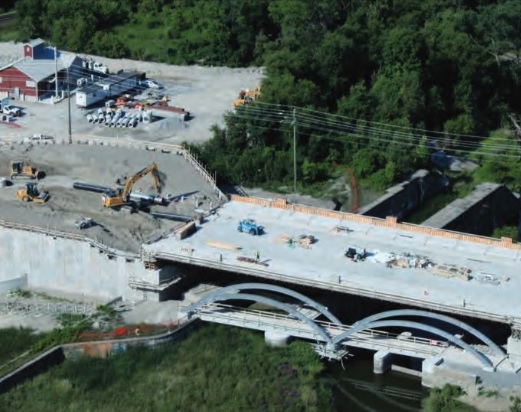
A trio of aggrieved developers and consultants make their way to the microphone. They are, to varying degrees, unhappy.
First up is Randy Grimes (real name not an alias) from the IBI Group but speaking for BILD's "York Chapter" which sounds kinda threatening. Then there's the eloquent Maria Gatzios from Gatzios Planning. And, bringing up the rear, the flamboyant Marco Filice from the Liberty Development Corporation. He speaks on behalf of nine development project owners in York Region.
I notice his smart leather briefcase is sitting on top of a banker's box which, in turn, sits on a little trolley with a telescopic handle. He has a heavy caseload. When he is not giving his presentation he is gazing intently at his cell phone, one ear cocked towards the podium.
Important new roads deferred and delayed
The Region's new Revised Background Study is a huge document, intimidating in its thickness. The developers - made corporeal by Randy Grimes - complain that too many roads projects have been shuffled into a "contingent list". The money is not there to pay for them. The developers are upset and feel short-changed.
Now it is the turn of planning consultant Maria Gatzios who speaks clearly in well formed sentences. She says there is a mismatch between big infrastructure projects which are, apparently, 100% funded and roads which are 50% funded. She points to a long list of unfunded projects in Appendix G of the fat tome. I go to page 473 and, true enough, I see pages and pages of roads projects that appear to be parked, going nowhere soon.
Ms Gatzios says the Region's own Transportation Master Plan is a work of fiction when some of its key projects are not funded. I made that up but you get the idea.
Now Mr Felice is at the microphone talking us through his slideshow. He points to ancient policies and pronouncements from York Region, drawn from their own documentation, that have never been acted on. They don't follow through. He thinks this will help his case.
Higher Development Charges. Is that what the developers want?
Frank Scarpitti from Markham wants to know if developers are prepared to see higher DCs if the contingency projects are put in the main list. Ms Gatzios says she's just a consultant planner but the "necessary projects" have got to be in the list.
Newmarket's John Taylor cunningly asks if she has the support of the entire development community for DCs to go up - even if it doesn't affect them personally as their projects don't need new infrastructure to go ahead.
Ms Gatzios is getting a lot of questions - I suppose because her presentation was interesting and easy to follow and she invited them. She says it is, inevitably, a balancing act. But there is real alarm out there that there are so many gaps in transportation spending.
"You are hearing from the development community that significant things are missing."
Van Trappist's question 
Now the Trumpets blast! The cymbals clash! A hush descends and the Chamber falls silent. It is time for Van Trappist to ask his annual question, justifying his York Region "stipend" of $54,337.92 a year.
"What about site specific development charges?"
A decent enough question but is it worth $9,056 per word?
Now the Region's affable Bill Hughes - the man in charge of the money - moves to the microphone. He affects a gentle professorial air. Looking at his students, seated around the hemicycle, he says he is going to present a structured argument on "Financial Sustainability". They wait to hear what the great man is going to say.
He starts by telling them:
"When you bring a problem to politicians you (must) also bring a solution."
Hmmm. We all wonder what's coming next.
He says Southern Ontario is growing but the distribution of that growth is uneven. Toronto is growing faster than expected with 20,000 new people moving into the city every year since 2009. By contrast, the GTA is growing more slowly than expected.
Closing the fiscal gap
This means there is a "fiscal gap" which sounds painful. The development charges coming in are lower than predicted. But the Region still has to build the infrastructure to accommodate the newcomers - even if there are fewer than expected.
He says development charges do not cover growth. This used to be unsayable but now it is the received wisdom. I learn that York Region has the highest debt per capita in Ontario - or is it the Western Hemisphere? Anyway it is three times Peel's and nine times Durham's.
Infrastructure is expensive but it supports growth. Water comes up. Sewage goes down. Hughes quotes his excellent colleague, the head of engineering, Erin Mahoney.
"We do not have a straw to the lake."
But building this infrastructure is not pain free. Debt servicing costs are significant. And if the projects in the contingency list became live then those costs would be "significantly higher".
Food for Thought 
Now I see the Regional Chair, the Great Potentate, Wayne Emmerson, shuffling in his big chair. This usually signals he is about to say something profound. True enough. He looks at Bill Hughes and says:
"You've given us food for thought. We have to live within our means, just like everyone else."
Now Markham's Jim Jones wants to know why Hughes is so surprised by Toronto's turbocharged growth and what effect the proposed foreign buyers tax will have.
Now Hughes is talking again about closing the fiscal gap which is not going to happen:
"Unless the Council is prepared to do very terrible things."
By this I assume he means putting up taxes.
Vaughan's Gino Rosati squeaks:
"This is a reality check!"
We don't have enough money
Now Hughes adds, darkly:
"The bottom line is we don't have enough money."
He says the best path is to find new sources of revenue such as those available to the City of Toronto. Land Transfer Tax. Vehicle Licensing and so on.
Now it is the turn of Markham's Frank Scarpitti, il capo di tutti capi.
He says our needs are as great as Toronto's and the DCs will have to be paid.
"We are gonna get that money."
He smiles but, as always, there is a hint of menace.
"We are gonna get that money even if we have to build a wall to keep people in. It may take longer to get the money but we'll get the money."
The temperature in the Council Chamber drops a few degrees. The developers feel a chill in the air.
New tax powers needed
Now he is talking about pushing a rope up a mountain, getting the cash they need for all their projects. He wants new tax powers from the Province.
The school swat, Markham's Jack Heath says we've heard realism we haven't heard before.
Now Newmarket's John Taylor is wondering if and when all the development charges will be collected. He talks about a future full of "precariousnesses"
"What if growth doesn't happen as projected?"
Taylor has been sitting next to the old banker for too long. He is worried about being saddled with debt we can't pay off.
Now Vaughan's Maurizio Bevilacqua, York Region's resident philosopher, pronounces:
"When there is confusion, you seize the moment!"
He wants to ask people how much they are prepared to pay in taxes! I think I know the answer he will get.
He says his colleagues can try to finesse the debate but facts are facts - there's not enough cash.
On that we can all agree.
This email address is being protected from spambots. You need JavaScript enabled to view it.
- Details
- Written by Gordon Prentice
We are now less than two weeks away from the OMB Clock Tower prehearing and we still do not know the terms of the "agreement in principle" that was entered into by the Town and Bob Forrest in closed session of the Committee of the Whole on 24 June 2013. 
That's why I am taking a deputation to the Council on Monday (24 April). It will be my final stab at getting the information before the OMB process starts. Then it will be brought up formally as an issue.
We know some kind of agreement exists. On 5 September 2015, Forrest told his business partners:
"Bob Sheaffer is drafting the land swap agreement. When we are happy with it, it will be reviewed by the Mayor and senior staff, then we must go before Committee of the Whole in camera to seek their blessing on it. We already have their agreement in principle."
On 23 February 2016, the then Town Solicitor, Esther Armchuk, told me the Council received a land exchange request from the Clock Tower developer but deferred any final decision until the application for a zoning by-law amendment received approval from the Council. As we know, it was denied. She told me:
If or when the developer's development application comes before Council, the details of the requested land exchange will likely become public information."
That hasn't happened.
What's the big secret?
So why is it so important to keep this information under lock and key?
If councillors were told that the proposed land swap could mean some public parking spaces under Market Square that wouldn't come as a huge surprise.
But were they aware that the land swap would allow for the manipulation of the Clock Tower development's FSI which would, in turn, have a direct impact on the development's built form? This would allow Forrest's development to appear much bigger than its neighbours on Main Street, shattering the Town's existing FSI and height standards for the old downtown.
At the statutory public meeting on 9 May 2016, Forrest remarked in his insouciant way:
"There is no issue of a failure for us to be to scale."
Excuse me? We now know the success of the entire project depended on a covert manipulation of the development's FSI.
On 27 March 2017, the Town told me:
"The Town maintains its position to continue to withhold the records at this time. Council discussions related to any land transaction that has not or will not close(d) remain confidential until such a time as their disclosure will no longer have an impact."
Clock Tower and Glenway
Of course, this very same strategy was deployed during the OMB Glenway Hearing.
The Board, in its written decision on 18 November 2014, observed:
"There is no evidence before the Board that the Town took any steps to acquire these lands for public open space and public park purposes."
In fact, on 17 March and 28 April 2008, the Town considered in closed session the possible purchase of the Glenway lands but decided, on the recommendation of the CAO, Bob Shelton, that
"the Municipality was not in the golf course business and the property should not be pursued."
Of course, the Town should not have asked itself whether it was in the golf course business but whether the Glenway lands should be acquired for public open space purposes. At that time it was private open space.
The Town consciously chose not put this information before the OMB.
Changing the dynamic
Had it been made available to the public at that time it would have changed the whole dynamic.
Instead it came to light as a result of a Freedom of Information request I submitted (along with the Glenway Preservation Association) on 24 June 2015.
What does this tell me about the whole OMB process?
Plainly, it is not about getting to the truth.
It is about gaming the system to get the result you want.
These days (and, admittedly, with the benefit of hindsight) it would have been an astute move for the Town to acquire the Glenway lands for public open space.
Of course there is a big difference between Glenway and the Clock Tower. Back in 2014, during the OMB Glenway Hearing, we didn't know the Town had considered buying the Glenway lands. But we do know the Town has an agreement in principle with Bob Forrest.
The OMB will know that too.
I doubt that the Town will be able to keep details of the agreement in principle under wraps
"until their disclosure will no longer have an impact."
This email address is being protected from spambots. You need JavaScript enabled to view it.
Page 174 of 286