Tomorrow (Wednesday 17 December 2025) I shall be taking a deputation to the Library Board. It's meetings are open to the public but are not streamed.

The agenda includes a report from the Chief Executive on Library Statistics.
Here is my commentary on it.
To: All members of the Newmarket Public Library Board
Deputation on 17 December 2025: The Conduct of the Chief Executive, Tracy Munusami
Commentary on CEO’s Report on Library Statistics (agenda item 6.1)
To recap. What action am I requesting?
(1) The Library Board and the Chief Executive should follow the definition of “active cardholder” as set by the Province. And the figure reported to the Province in the Annual Survey of Public Libraries should be included in the Library’s “Report to the Community 2025”
(2) The Chief Executive should report to the Library Board quarterly on membership renewals and lapses. The Board may wish to consider asking the Chief Executive for an annual report on the split between Newmarket and out-of-town (or non-resident) members and Library membership by ward. The Board has received such reports in the past. The latter at the request of Councillor Bisanz.
(3) The Chief Executive should be asked to give a presentation to the Board on the capabilities of Polaris to aid members’ understanding of what it can do.
Deputation Issue 1. Definitions. The “key issue” as set out in my Deputation is the definition of “active cardholder”. Earlier this year, the Chief Executive changed the Province’s definition of active cardholder and substituted her own – without approval of the Board or, so far as I know, the Library Board Chair. I am asking the Board to reinstate forthwith the Provincial definition.
The Chief Executive says
“systems limitations prevent capturing all form of library service in one integrated platform”.
If that is the case, then she should count what can be counted and tell the Province what she cannot count – for example, members who use the library as a public space for study. Clearly, this does not require the use of a membership card.
She should also tell the Province that she chooses not to track members signed up through outreach and that it is impossible, therefore, to determine when the member becomes an “active cardholder” according to the Provincial definition. The CEO believes tracking new members signed up through outreach is an invasion of their privacy. This is nonsense.
The CEO says the Ministry defines an active member as
“cardholders who have used their library card in the past two years”
and acknowledges that
“while this is a clear definition, system limitations make it challenging to fully meet this standard”. (My underlining for emphasis)
The answer is to follow the Provincial definition but with the caveats above.
The CEO relies on undated correspondence from Douglas Davey, a library services adviser in the Ministry, to help make her case. Unfortunately, we are not told what question or point he was answering. In any event, what we have is incoherent. Mr Davey is quoted as saying:
“We understand that Newmarket PL has opted to use the number of unexpired cards in its integrated Library System to calculate A1.14 Number of Active Cardholders.
“As you have set your cards to expire every two years then you are counting everyone who has used their card in the last two years as well (as) any patrons who have received a card in the last two years but haven’t used it in a way that is formally counted (eg participating in a drop-in program). We have no concerns with this method or the integrity of the data.”
This is gobbledegook. We now have a Provincial definition of “active cardholder” that requires a membership card to be used in the last two years. Or not used. Take your pick.
If we are to accept Mr Davey’s interpretation of the Provincial definition, we might as well use Ms Munusami’s definition: an active cardholder is a member with an unexpired library card.
If the Board is minded to adopt the CEO’s new definition then it should first seek an authoritative statement from the Province. If the Newmarket definition is to be the new template this will have Ontario-wide ramifications.
Deputation Issue 2. Membership renewals and lapses. 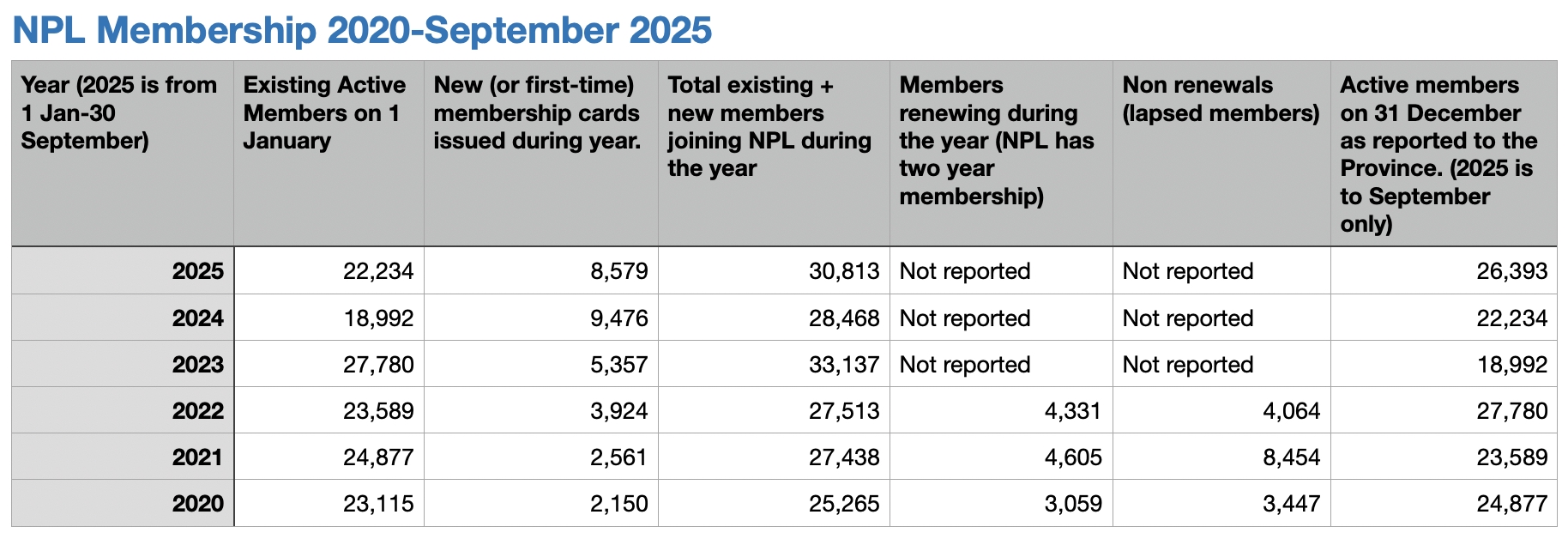
On 4 July 2025 the Chief Executive told me:
“Retention is a focus this year.”
Despite this, the Library now no longer tracks membership renewals. And yet, paradoxically, data on renewals can be extracted as and when required.
In her report to the Board (page 3) she writes:
“Memberships remain active for two years and will expire unless the patron renews their membership in-person, on-line or over the phone. This figure is updated monthly and includes new sign-ups, renewals, on-going memberships, while removing expired memberships.”
The previous Chief Executive, Todd Kyle, reported monthly membership renewal figures to the Library Board for years. These were compiled manually. But now, despite using a “modernized” reporting system, we are asked to believe that renewals data cannot be generated.
The Board is told the Statistics Dashboard provides a broad overview of trends and progress in key service areas. But renewals and lapses are completely ignored. Wouldn’t a sharp decline in renewals and an increase in lapsed memberships be a cause of concern?
The CEO tells the Board on page 4 that:
“At present, Library staff are not aware of any method to extract renewal data from the Integrated Library System (Polaris)”
She adds:
“To confirm, the IT Department contacted Polaris directly to determine whether this functionality exists. Polaris has responded with:
“Polaris does not currently have a way to track or report on patron library card renewals.”
NPL’s Strategic Plan 2022-2025 confirms the Library
“uses Polaris (iii) ILS on virtualised machines and the system is stable. Library IT staff provide ILS management, technical support and staff training. NPL can consult with the vendor to review modules to enhance service by reducing inefficiencies.”
A count of cardholder renewals in any given period can be produced by providing parameters for expiration dates, registration date and patron status to any one of (a) the built-in Polaris staff client (how it describes its report generator); (b) the SimplyReports add-on or (c) basic Structured Query Language – all three of which are included in the Polaris packages for which the Library has subscriptions.
For example, SimplyReports:
“gathers data from the Polaris database, allowing you to create reports about your patrons, patron account transactions, holds, and items. SimplyReports provides you with information you would expect to find in the Reports and Notices feature in the Polaris Integrated Library System, yet is more robust and gives you more control. SimplyReports allows you to select the values, parameters, and format to create truly customizable reports.”
There are other software solutions out there such as Savannah by OrangeBoy.
Deputation Issue 3: The Chief Executive should be asked to give a presentation to the Board on the capabilities of Polaris to aid members’ understanding of what it can do.
The Chief Executive says that:
“At the time of writing this report, Library staff are actively exploring an option to accurately track and report expired cards on a monthly or quarterly basis.”
This could provide the basis for a presentation along the lines I have proposed.
The Chief Executive says that:
“As part of the next round of strategic planning the Library Board and staff can consider the capabilities of Polaris when developing or refining metrics for organisational performance. This will ensure that reporting expectations align with what the system can realistically deliver and support informed decision-making.”
Why should the Board wait that long? Why is it unrealistic to want information on membership renewals? For years the Board used to get that information as a matter of course.
We all want informed decision-making. But, clearly, the Board is flying blind.
Gordon Prentice
16 December 2025
The Chief Executive mentions NPL’s Strategic Plan 2022-2025. It is here.
