


The use of uniformed York Regional Police officers as stage props in election campaigns is more widespread than I thought.
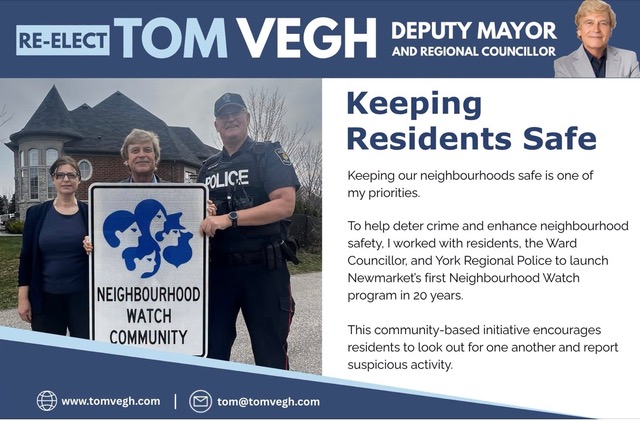
This one from Tom Vegh looks innocent enough. Who would be against a Neighbourhood Watch scheme? No-one could possibly be against the idea of keeping residents safe.
But the photo showing Vegh with York Regional Police Officer Riczard Wojtulewicz explicitly promotes Vegh's re-election as Deputy Mayor and Regional Councillor.
I am left wondering if Constable Wojtulewicz
- Was aware that the photograph was being used in Tom Vegh’s re-election campaign
- Was asked by Vegh or anyone acting on his behalf for his permission to use the photograph for election campaign purposes
- Consented to its use in this context
And, importantly, were York Regional Police aware of, or did they authorise, the use of this photo in Tom Vegh's campaign?
I am in touch with York Regional Police about this.
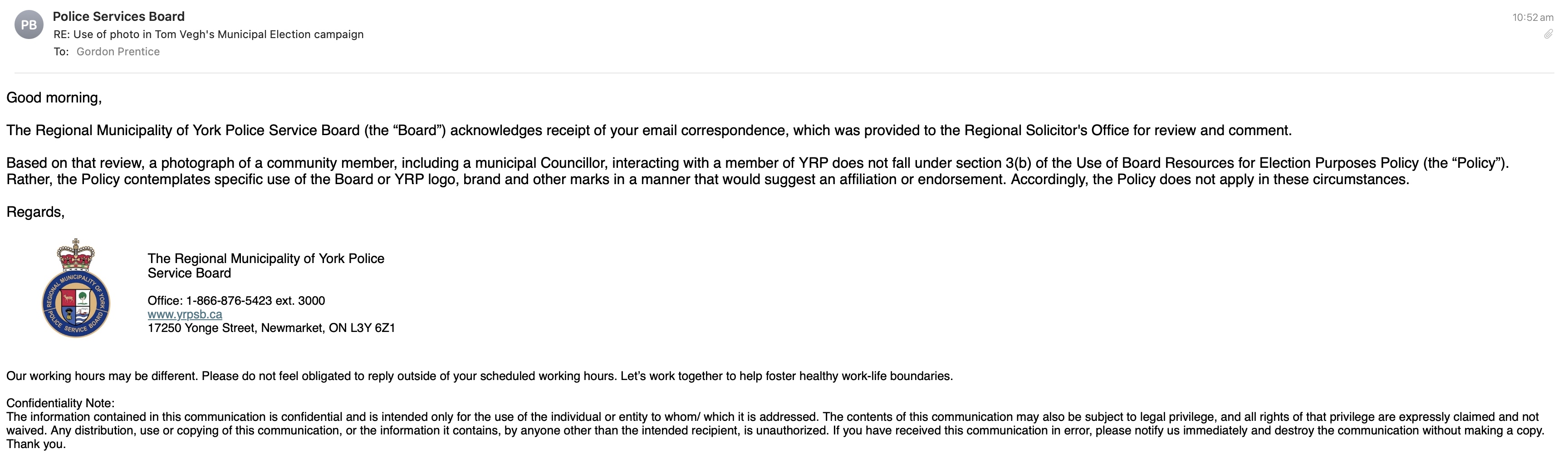
Update at 13.10 on 13 October 2026: This morning I received a reply from the Regional Solicitor which says the photo above is in order.
I have now filed a complaint with the Inspector General of Policing in Ontario. (Click 'Read more" to see both.)
Update on 14 October 2026: Email from the Inspectorate of Policing saying the matter is outside its jurisdiction. (See below)
13 October 2026
Inspector General of Policing
Inspectorate of Policing, Ontario
Dear Inspector General,
Re: Complaint concerning the York Regional Police Service Board’s election policy and the use of uniformed officers in campaign materials
I wish to make a formal complaint about the York Regional Police Service Board’s Use of Board Resources for Election Purposes Policy, and its interpretation as permitting a photograph of a uniformed York Regional Police officer to be used in a candidate’s election materials.
The immediate example is an election flyer featuring Tom Vegh, who is seeking re-election as Newmarket’s Deputy Mayor and Regional Councillor, alongside uniformed Constable Riczard Wojtulewicz. The material carries the words “Re-elect Tom Vegh”.
After reviewing the flyer, the Regional Solicitor advised me:
“Based on that review, a photograph of a community member, including a municipal Councillor, interacting with a member of YRP does not fall under section 3(b) of the Use of Board Resources for Election Purposes Policy (the ‘Policy’). Rather, the Policy contemplates specific use of the Board or YRP logo, brand and other marks in a manner that would suggest an affiliation or endorsement. Accordingly, the Policy does not apply in these circumstances.”
This interpretation raises a serious concern about the protection of police political neutrality and the officers themselves.
A photograph taken during an ordinary community interaction acquires a different purpose when incorporated into material expressly urging voters to re-elect a candidate. Whatever the original circumstances, its subsequent campaign use may give voters the impression that the officer, or the police service, supports that candidate.
A police uniform is a recognisable symbol of public authority. I ask you to examine whether the policy adequately addresses the electoral use of that authority, including any police insignia or identifying marks visible in the photograph.
The published wording of section 3(b) prohibits the use of the Board’s and YRP’s logo, brand and other marks in campaigning. It does not expressly state the additional requirement, described in the Solicitor’s response, that their use must suggest affiliation or endorsement. I would welcome an explanation of the basis for that interpretation.
The wider policy also restricts campaign use of police resources and employees, the use of photographs produced for or owned by the Board or YRP, and employees identifying themselves as Board employees when engaging in political activity. I ask that these provisions be considered together, rather than treating section 3(b) as the sole relevant provision.
The officer’s consent
I do not know whether Constable Wojtulewicz knew about, or consented to, the use of his photograph in Mr Vegh’s campaign. I am not alleging misconduct by the constable.
However, the Solicitor’s response does not address consent or identify any safeguard against an officer’s image being repurposed for election campaigning without their knowledge. Agreeing to a photograph during a community interaction should not automatically be treated as agreeing to its subsequent use in a candidate’s campaign.
Even informed consent would leave a separate question: whether the use of a uniformed officer in campaign advertising is compatible with maintaining the police service’s actual and perceived political impartiality.
I therefore ask your office to:
- Register this as a complaint about the Board’s policy and its application.
- Examine whether the policy, as interpreted, adequately protects police political neutrality and meets the applicable requirements of Ontario’s policing legislation and regulations.
- Establish whether the constable knew of and consented to the campaign use, and whether YRP or the Board authorised it.
- Clarify how the policy applies to campaign photographs showing uniformed officers, including visible police insignia, and whether the photograph’s origin or ownership affects that assessment.
- Consider what amendments or guidance are needed to prevent community policing photographs from being repurposed into election advertising without appropriate safeguards.
- Advise whether any corrective action is warranted concerning this flyer.
Given the municipal election on 26 October 2026, I would appreciate prompt consideration, including advice on any interim steps available.
If you refer the complaint to the Board, please ask it to address these questions specifically and provide a reasoned written response. Simply repeating that section 3(b) does not apply would leave the underlying policy concern unanswered.
Please acknowledge receipt and advise how the complaint will be handled.
Yours sincerely,
Gordon Prentice
________________________________________________
From the Inspectorate of Policing 14 October 2026
Dear Gordon Prentice
Re: IOP Complaint Number: 26-1086
The Inspector General of Policing has reviewed the complaint that was submitted on October 13, 2026, regarding the York Police Service. We take these concerns seriously; however, some matters raised fall outside the legislative mandate of the Inspector General.
On careful review, the complaint mainly raises a dispute between your organization and the police service on a subject-matter that falls outside of the Community Safety and Policing Act, 2019 (CSPA) and the jurisdiction of the Inspector General to address.
In the event the dispute and subject-matter did fall within the jurisdiction of the Inspector General, it is the Inspector General’s opinion, having regard to all the circumstances, that it would not be in the public interest to investigate this complaint for the reasons below (in accordance with section 107(2)(b) of the CSPA).
Complaint Summary (main aspects)
The complaint challenges the interpretation and adequacy of the Board’s "Use of Board Resources for Election Purposes" policy. The complaint was triggered by an election flyer for Tom Vegh (candidate for Newmarket’s Deputy Mayor/Regional Councillor) that features a photograph of him alongside a uniformed YRP officer, Constable Riczard Wojtulewicz, with the text “Re-elect Tom Vegh. The complaint alleges:
- Using a uniformed officer in campaign materials leverages a symbol of public authority, giving voters the impression that the officer or the YRP endorses the candidate.
- The Regional Solicitor ruled the policy didn't apply because a community interaction does not use the logo or brand in a way that suggests endorsement. The complainant argues this interpretation is too narrow and fails to protect political neutrality.
- The complaint highlights that there is currently no protection to prevent an officer's image, taken during routine community policing, from being repurposed for a political campaign without their knowledge or informed consent.
The Inspector General of Policing’s mandate
The Inspector General of Policing has jurisdiction over complaints related to compliance with Ontario's Community Safety and Policing Act, 2019 (CSPA) and its regulations by police services, police service boards, and organizations that employ special constables. The Inspector General of Policing also responds to complaints about adequate and effective policing, the policies and procedures of boards and chiefs of police, and allegations of misconduct by police service board members.
The Law Enforcement Complaints Agency’s mandate
The Law Enforcement Complaints Agency (LECA) is responsible for receiving, managing and overseeing public complaints about misconduct of police officers, including: all municipal, regional, and provincial (OPP) police officers; Special Constables employed by the Niagara Parks Commission; Peace Officers in the Legislative Protective Service; and First Nations police officers if the police service opts into the Community Safety and Policing Act, 2019 (CSPA). As an independent civilian oversight agency, the LECA ensures all public complaints against the police are dealt with in a manner that is transparent, effective and fair.
Decision
The Inspector General of Policing’s (IoP) authority to address complaints is outlined in sections 106 and 107 of the CSPA. All complaints are carefully reviewed, and rigorously evaluated, and the Inspector General follows a thorough assessment process to determine which matters warrant further action. However, the Inspector General can only accept complaints that fall within the scope and authority of the Inspector General.
The Inspectorate of Policing operates strictly under the Community Safety and Policing Act, 2019 (CSPA). Its legislative authority is confined to ensuring compliance with policing laws, regulations, and standards by police services, police service boards, and special constable employers. The Inspectorate has no jurisdiction over political candidates, municipal election campaigns, or the contents of campaign flyers. Issues surrounding election materials and candidate conduct are governed by the Municipal Elections Act and are typically overseen by municipal Clerks, Compliance Audit Committees, or Municipal Integrity Commissioners.
While your complaint focuses on policy, requests to investigate whether an individual officer knew of or consented to a photograph's use touch upon officer conduct. Under Ontario’s civilian oversight system, the Inspectorate does not investigate individual officer conduct or disciplinary matters. Complaints regarding the conduct of a specific police officer are under the sole jurisdiction of the Law Enforcement Complaints Agency (LECA).
Although the Inspectorate does accept complaints regarding police service board policies, its review is limited to whether a policy or its implementation violates the CSPA or its regulations (such as failing to provide adequate and effective policing). A board's interpretation of its own administrative policies such as a corporate policy governing the "Use of Board Resources for Election Purposes" does not automatically constitute a violation of provincial policing legislation, unless it directly compromises the statutory delivery of adequate and effective policing services.
Sincerely,
Police Service Advisor
The Inspectorate of Policing